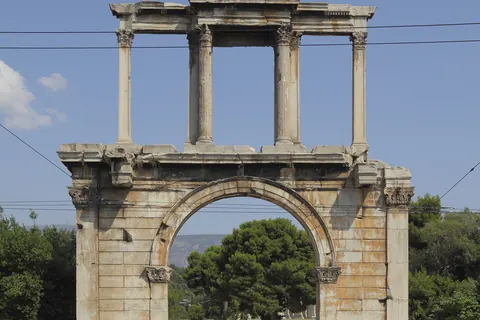
The Arch of Hadrian, most commonly known in Greek as Hadrian’s Gate, is a monumental gateway resembling, in some respects, a Roman triumphal arch. It spanned an ancient road from the center of Athens, Greece, to the complex of structures on the eastern side of the city that included the Temple of Olympian Zeus.
It has been proposed that the arch was built to celebrate the adventus of the Roman emperor Hadrian and to honor him for his many benefactions to the city, on the occasion of the dedication of the nearby temple complex in 131 or 132 AD. Since Hadrian had become an Athenian citizen nearly two decades before the monument was built, Kouremenos has argued that the inscriptions on the arch honor him as an Athenian rather than as the Roman emperor. It is not certain who commissioned the arch, although it is probable that it was the citizens of Athens. There were two inscriptions on the arch, facing in opposite directions, naming both Theseus and Hadrian as founders of Athens. While it is clear that the inscriptions honor Hadrian, it is uncertain whether they refer to the city as a whole or to the city in two parts: one old and one new. The early idea, however, that the arch marked the line of the ancient city wall, and thus the division between the old and the new regions of the city, has been shown to be false by further excavation. The arch is located 325 metres southeast of the Acropolis.
Sources
Text: introduction of the Wikipedia article Arch of Hadrian (Athens), under the CC BY-SA 4.0 licence (authors: article history). Facts: Wikidata (CC0). Coordinates: Wikidata, map background © OpenStreetMap contributors.